November Update from the CEO: Resistance Requires Solidarity
With the federal government shutdown finally behind us, what’s driving the headlines now is the new spending and with it, the stark reality of what’s being sacrificed. The latest budget bill cuts deep into Medicaid, threatening to rip away access to reproductive and sexual health care for millions. According to the Guttmacher Institute, these changes will “devastate coverage” for reproductive health.
As non-profit workers, we are closer to needing benefits than becoming billionaires, and still, the dominant narrative treats economic injustice as personal failure. The story is old and tired. The systems that police our bodies, our borders, and our ability to survive are the same ones that currently decide who is worthy of care. Reproductive justice, economic justice, and immigration justice are not separate fights. They are different faces of the same struggle for dignity and self-determination.
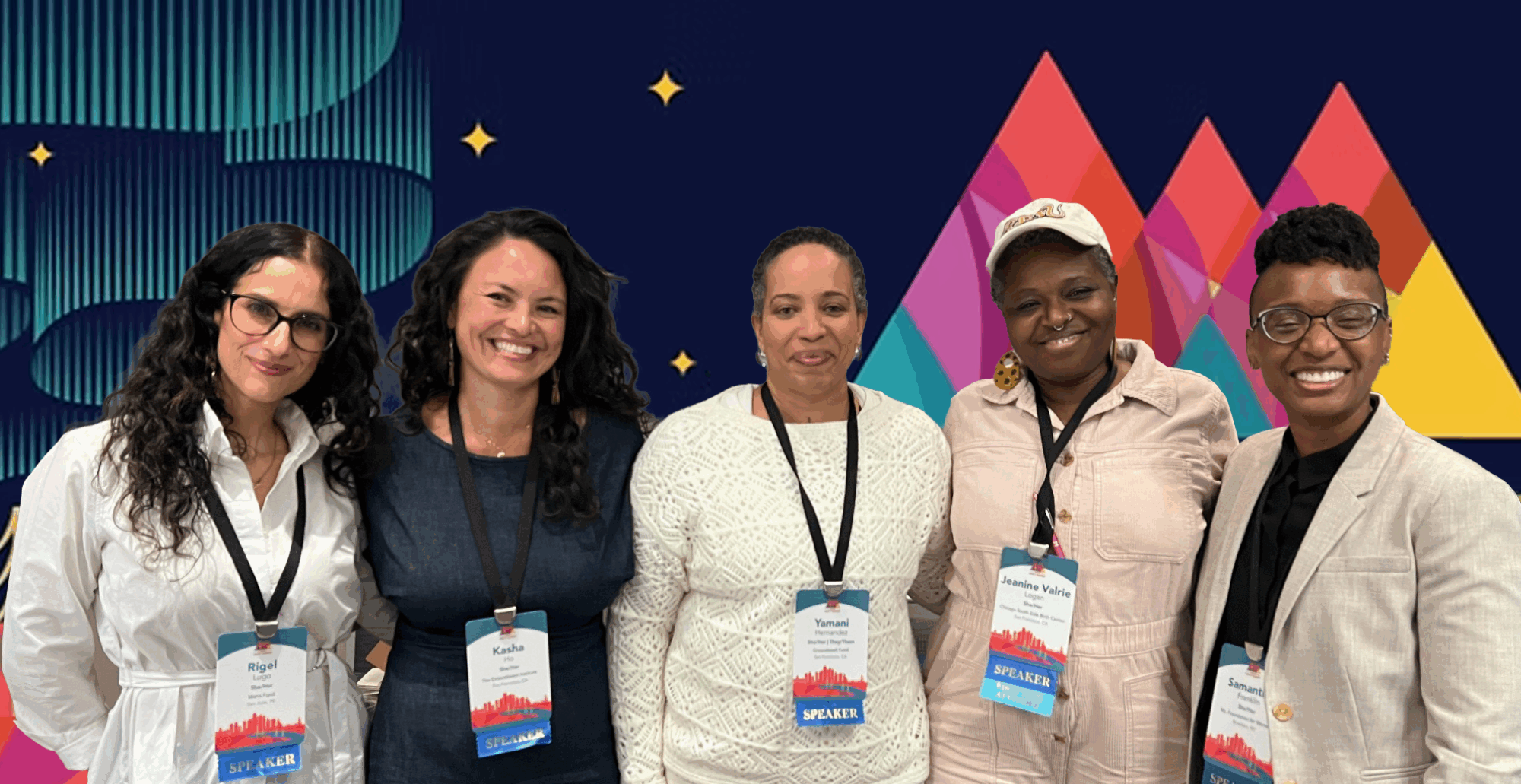
Rigel Lugo (Maria Fund), Kasha Ho (The Embodiment Institute), Yamani Yansa Hernandez (Groundswell Fund), Jeanine Valrie Logan, CNM, MPH (Chicago South Side Birth Center), and Samantha Franklin (Ms. Foundation for Women) at CHANGE Philanthropy’s 2025 Unity Summit. Their panel, “Beyond 501(c)(3)s: Resourcing Resistance in Philanthropy’s Retreat,” explored how funders can move resources toward bold, community-rooted solutions.
That’s why spaces like CHANGE Philanthropy’s Unity Summit matter. It reminds us that while the crises we face are interconnected, so are the solutions. At the Summit, I moderated a panel alongside representatives from the Ms. Foundation for Women, The Embodiment Institute, Chicago South Side Birth Center, and the Maria Fund to discuss how we have to find new ways to fund our movements and build infrastructure beyond the grantmaking cycle. The biggest takeaway? A significant knowledge gap remains for folks on the ground on how to expand income streams, own property, start social enterprises, and consider business models that prioritize solidarity over extraction. We must begin by sharing information and bridging the gap, especially for communities that have long been denied both knowledge and resources.
As we reflect on Trans Day of Remembrance, that call feels even more urgent. Trans communities have long built networks of care and survival amid systemic violence and erasure. They’ve shown us what resilience looks like and what freedom can look like when we resource those already leading the way.
We also honor the legacy of Alice Wong, whose voice as a clarion call for disability justice, storytelling, autonomy, and community, and we hold in our hearts the recent loss of Miss Major, a lifelong fighter for trans liberation, abolition, and the survival of transgender and intersex people. Losing giants like Alice and Miss Major – people who devoted their entire lives to our collective freedom – is a profound blow to our movements. Their work reminds us that no one’s liberation is separate from the liberation of all. We carry that truth forward.
Groundswell’s work is about closing those gaps – between privilege and proximity, access and autonomy. When you give to Groundswell Fund, you’re not simply donating; you’re investing in the infrastructure of freedom that feeds, heals, and sustains our movements. Your support ensures that those most impacted have the resources, autonomy, and power to lead us all toward collective liberation.