Bodily Autonomy Is the Fault Line of Democracy
Like us, you are likely still reeling from the Supreme Court of the United States (SCOTUS) gutting voting rights earlier this month. As if that were not enough, in the coming weeks, SCOTUS will issue a slate of decisions that could even further reshape the boundaries of rights and protections in this country. Cases like West Virginia v. B.P.J. and Little v. Hecox put transgender youth directly in the crosshairs. Others, including Trump v. Miot and Trump v. Barbara, signal broader efforts to narrow immigrant protections and expand executive authority.
These decisions are often framed as inevitable turning points, but nothing about this moment is inevitable. Now more than ever, we fight to hold the line on our rights and abilities to make decisions about our bodies, our families, and our futures. This is what makes meaningful participation in democracy possible.
Across the country, our grantee partners are organizing at this exact intersection of bodily autonomy and democracy. They are not waiting on court decisions; they are actively shaping what comes next. This is how democracy is practiced and defended every day:
- In Alabama, the Yellowhammer Fund secured a decisive victory protecting the right to support people seeking abortion care across state lines—affirming both free speech and the fundamental right to travel.
- In Louisiana, Birthmark Doula Collective challenges a law that criminalizes access to essential reproductive healthcare, placing life-saving medication within a system already defined by over-policing and racialized incarceration.
- In Michigan, Mothering Justice helped secure a state supreme court ruling that upheld the will of voters, ensuring that minimum wage increases and paid sick leave protections move forward for working families as originally enacted.
- In Florida, Commonsense Childbirth is calling for justice in cases where birthing people were forced into unnecessary surgical procedures, highlighting the ongoing reality of obstetric violence and the erosion of bodily autonomy within medical and judicial systems.
- In Texas, the Transgender Education Network of Texas is supporting a legal challenge to censorship laws that attempt to erase discussions of race, gender identity, and sexuality from public education.
This work is not adjacent to democracy. It is how democracy is practiced and defended every day.
These partners are deeply rooted local and state-based organizations with budgets under $5M in the South, Southwest, Midwest, and U.S. territories—regions where attacks on bodily autonomy and democracy are often most acute, and where communities are building some of the most innovative and thorough responses. Across abortion access, birth justice, and trans liberation, as they intersect with civic engagement and organizing for both cross-sector policy change and systems of care, these organizations are protecting people’s ability to make decisions about their bodies, families, and futures while building community-led systems of care, safety, and power.
Too often, this work is treated as issue-specific, rather than as foundational to democratic stability. At a time of escalating political attacks and tightening resources, movements have been clear about what is needed: not more small, fragmented grants, but larger, sustained investments that allow them to build real power.
In 2026, we sharpened our approach from a broad distribution model to a smaller cohort of partners, resourcing fewer organizations with deeper, more substantial support. Many of these groups are longtime movement partners we have funded for years with your support. This shift reflects our commitment to ensuring organizations on the frontlines of bodily autonomy and democracy have the resources required to withstand this moment and shape what comes after.
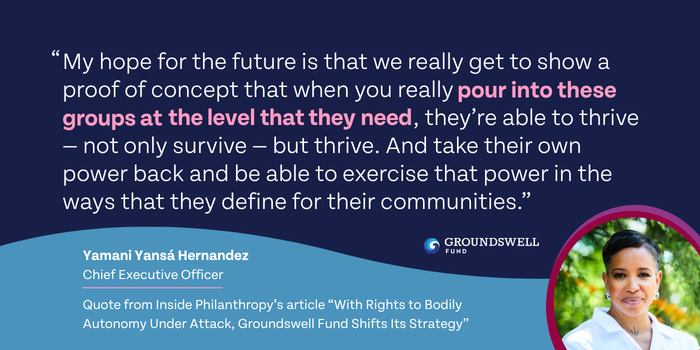
As noted in recent coverage by Inside Philanthropy [paywall], this shift reflects a broader reality: intermediary funders must adapt to ensure that movements have the resources they need to endure and win in a rapidly changing landscape. As I said in the article, “My hope for the future is that we really get to show a proof of concept that when you really pour into these groups at the level that they need, they’re able to thrive — not only survive — but thrive. And take their own power back and be able to exercise that power in the ways that they define for their communities.” Continuing this strategy over the next five years would mean investing $1M each in these groups. This is the scale that we are striving for, and more.
The SCOTUS decisions ahead will matter. But what matters just as much is what movements can do in response.
As Groundswell enters this next chapter, we do so with strong, committed boards we recruited last year and acknowledge a couple of transitions. We are deeply grateful to Daroneshia Duncan-Boyd, Founder and Executive Director of TAKE Resource Center, whose service on the Groundswell Action Fund Board since 2020 has helped guide the organization through a period of profound political change and growth. We also extend our gratitude to Afua Atta-Mensah, former Chief of Programs at Community Change, who has stepped off the board after being appointed NYC Chief Equity Officer and Commissioner by the Mamdani administration.
We thank them both for their leadership, vision, and commitment to movement-building. And thank you for sustaining movements fighting for bodily autonomy, care, and democratic participation. It is how we protect the possibility of a more just future.